
With a commitment to transforming healthcare outcomes and bolstering access in low- and middle-income countries, Community-based Management of Malnutrition (CMAM) is a program that uses trained community members to identify and refer children and pregnant and/or lactating women (PLW) who suffer from moderate acute malnutrition (MAM) or severe acute malnutrition (SAM) to supportive programming. Limestone Analytics was contracted to conduct an economic analysis of World Vision Canada’s investments in the CMAM program model, encompassing cost-benefit analysis (CBA) and cost-effectiveness analysis (CEA).
This project incorporated extensive desk and literature reviews focused on malnutrition-focused interventions and their impacts, from which Limestone identified the major expected impacts of CMAM and developed a methodology to quantitatively estimate those. Limestone then constructed spreadsheet-based analytical models to estimate the costs and benefits of World Vision Canada’s investments in 39 implementations of CMAM across 20 countries between 2019 and 2021.
Key to this analysis was the application of diverse primary data, including monitoring and evaluation indicators and malnutrition outcome data obtained from World Vision International’s CMAM database. Limestone delivered a final report to synthesize its analysis, highlighting the scope of the investments in CMAM, the estimated gains in human health, the costs per human health outcome, and the cumulative and net social benefits of these investments.
Limestone’s analysis estimated that WVC-funded investments in CMAM will avert approximately 71,000 disability-adjusted life years (DALYs) for children under five and 145 DALYs for pregnant and lactating women. Moreover, WVC-funded investments in CMAM will avert the deaths of more than 6,200 children under five. The net social return on WVC’s CMAM programming was estimated at more than $290 million (USD), yielding approximately $16.80 in social benefits for every $1 invested.
The CBA model included a dashboard that allowed WVC to modify the analysis in response to feedback from its subject-matter experts. Armed with this tool, WVC could rapidly re-estimate impacts upon the reclassification of selected projects, informing its 2023 Annual Results Report.
Limestone’s analysis has triggered internal conversation within WVC about concrete steps that can be taken to improve data collection for monitoring and evaluation, including the consistent recording of human health outcomes (e.g., cure rates) at the project level, which can drive tangible improvements in program efficacy and impact assessment.

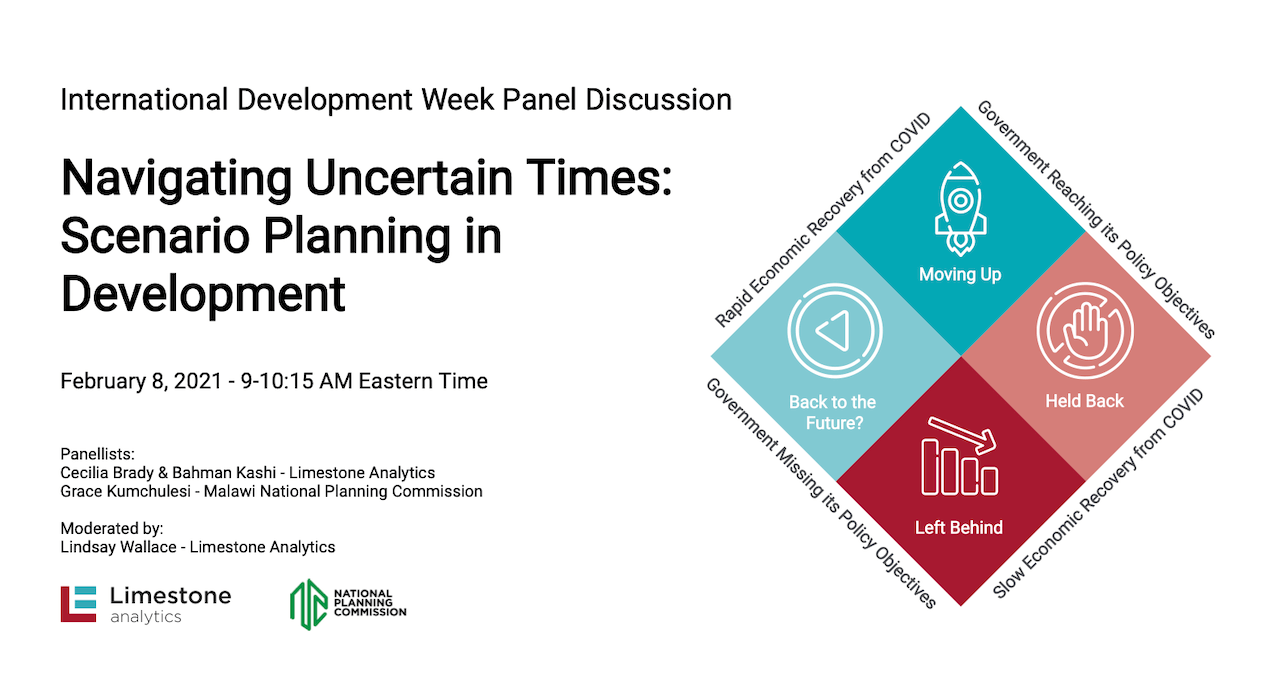
Join us this International Development Week to learn about scenario planning as a tool to navigate uncertainty in international development, and how scenario planning can be used in planning for […]

According to Limestone’s latest modeling, a more-intense early-year lockdown may be less costly for the Canadian economy in the long run. Limestone’s STUDIO model, which provides rapid-response policy analysis to […]